Undetectable. Multi-Fuel.
Lightweight Power.
Extend operational range. Maximize payload. Up to ~15× lithium-ion power density — stack-level, projected from validated MEA data. Highest specific power (kW/kg) fuel cell stack in its class. Silent, no thermal signature. Hydrogen, methanol, or ethanol on the same hardware. Built for Arctic cold and desert heat. Dual-use by design.
The Problem
The Power Burden Is a Tactical Liability
Modern defense demands portable, undetectable, reliable power across every climate — yet operations remain shackled to heavy batteries that fail in the cold and noisy generators that broadcast position.
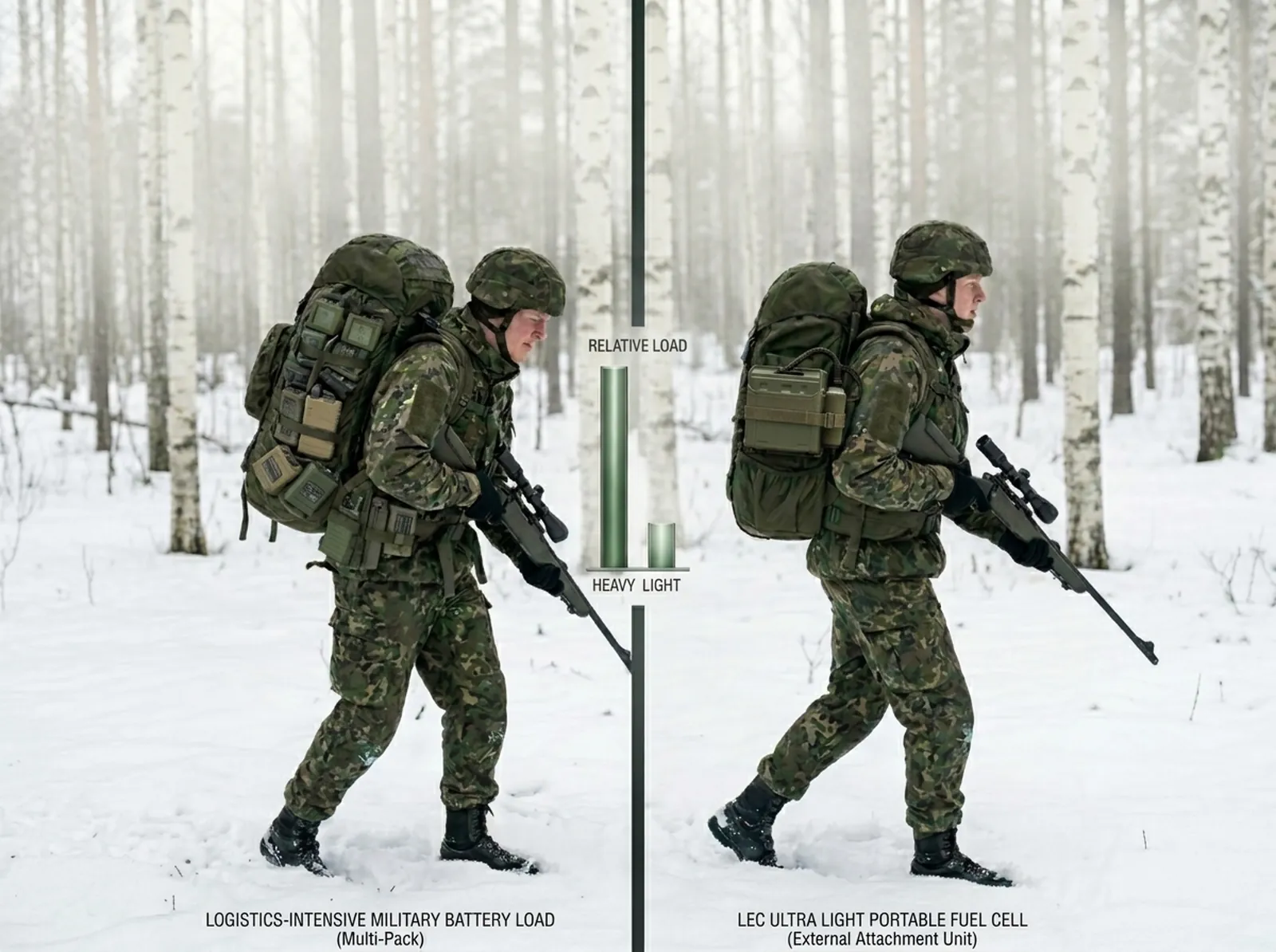
A dismounted soldier carries 9–18 kg (20–40 lbs) of lithium-ion batteries for a 72-hour mission. That weight degrades movement, increases fatigue, and limits the electronics a unit can bring. Worse: lithium-ion loses capacity sharply below 0°C and often fails entirely below −20°C — a daily operational reality for NATO operations in northern Europe, Arctic deployments, and US Northern Command.
Forward operating bases run on diesel generators that broadcast position through acoustic and thermal signature. Resupply convoys expose personnel to IED and ambush risk. Hydrogen-only alternatives need pressurized tanks too heavy and explosive to transport by rotary wing into contested zones.
The battery-generator dependency is not a logistics inconvenience. It is a force vulnerability.
Benchmark
Power Density Comparison
Where LEC sits against incumbent power systems on a watt-per-kilogram basis. LEC figures are stack-level, projected from validated MEA data.
Why LEC
Six Advantages That Change the Calculus
Power Density Dominance
Higher power density than lithium-ion, diesel generators, and other PEM fuel cells.
Multi-Fuel Logistics Advantage
Hydrogen, methanol, or ethanol — one stack. Water-flush switching, no hardware swaps.
Cold-Weather Resilience
Operates where lithium-ion fails. No cold-soak capacity loss.
Portable Across the Scale
From 25W soldier-wearable to 1kW squad-level generators. Modular, stackable, mission-adapted.
Low Thermal & Acoustic Signature
Near-silent. Operates ~60°C — invisible to acoustic and IR surveillance.
UAV & Unmanned Endurance
Land, air, sea. Battery UAVs run minutes; LEC-powered UAVs run hours.
Product Families
Systems Built for the Battlespace
Modular architecture allows rapid configuration for soldier-portable, vehicle-mounted, and aerial platforms.
25W / 50W / 100W
Soldier Wearable Power System
The personal fuel cell that replaces your battery burden. Body-worn or rucksack-integrated power generation for individual soldiers and special operations personnel.
| Power Output | 25W, 50W, or 100W continuous |
| Fuel Options | Hydrogen, methanol, or ethanol |
| Operating Temp | -32°C to +60°C |
| Target Weight | Under 6 lbs (incl. 72hr fuel) |
| Noise Level | Near-silent operation |
| Ruggedization | MIL-STD-810 target |
| Integration | SMBus-compatible |
500W / 1kW
Portable Military Field Generator
Squad-level power that one team carries and deploys in minutes. Replaces diesel generators that are heavier and announce your position.
| Power Output | 500W or 1kW continuous |
| Fuel Options | Hydrogen, methanol, or ethanol |
| Operating Temp | -32°C to +60°C |
| Runtime | 48+ hours on standard fuel load |
| Transport | Backpack (500W), team-carry (1kW) |
| Acoustic Sig. | Near-silent |
| Applications | FOBs, field hospitals, comms, command |
1kW / 2kW
UAV Power Pack
Extended endurance for tactical unmanned systems. OEM-ready form factor for integration into existing airframe and chassis architectures.
| Power Output | 1kW or 2kW continuous |
| Fuel Options | H₂ (primary), methanol (field refuel) |
| Operating Temp | -32°C to +60°C |
| Endurance | 4-10x vs lithium-ion |
| Weight | Maximum power density |
| Refueling | Field-refuelable with methanol |
| Integration | OEM-ready, modular mounting |
Use Cases
How Defense Teams Can Deploy LEC
Four mission-critical scenarios where multi-fuel, high-density portable power changes the operational calculus. Each scenario shows the problem, the LEC advantage, and the measurable impact.
Forward Operating Base Power
Diesel generators at a FOB consume 3,000–5,000 gallons (≈10–16 tonnes) of fuel per week. Every resupply convoy is a logistics operation requiring route clearance, armed escort, and exposing personnel to IED and ambush risk. The fully burdened cost of fuel in combat zones reaches $40–$400 per gallon (~$12–$125 per kg).
- Replace diesel with fuel cells — difficult to detect, low acoustic and thermal signature
- Power scales to demand — no idle burn, no fuel wasted at partial load
- Scalable from squad-level (1kW) to full base power (containerized MW)
- Multi-fuel flexibility: any available fuel keeps the base running

Dismounted Soldier Power
A 72-hour dismounted mission requires 20–40 lbs (9–18 kg) of lithium-ion batteries. That weight degrades movement speed by up to 15%, increases musculoskeletal injury rates, and limits the electronics a unit can bring to the fight.
- Single wearable system under 6 lbs (2.7 kg) replaces the full 72-hour battery load
- Continuous power for radios, NVGs, GPS, ECM — no charging stops
- Refuel in the field with methanol from any available source
- 60–80% reduction in carried power weight per soldier

Tactical UAV Endurance
Battery-powered Group 2 tactical UAVs are limited to 30–90 minute sorties. The intelligence picture goes dark during battery swaps. Three sorties per day is optimistic. Six hours of total flight time is exceptional.
- Extend flight endurance from minutes to 6–12+ hours per sortie
- Persistent ISR coverage — the intelligence picture never goes dark
- Forward refuel with methanol in minutes — no hydrogen logistics required
- OEM-ready power pack integrates into existing airframe architectures

Mobile Command Post Power
A brigade tactical operations center needs reliable power for communications, computing, and battle management systems. Conventional diesel generators produce 90+ dBA and thermal signatures visible to aerial IR sensors from kilometers away — turning the command post into a target.
- Near-silent operation preserves acoustic environment for OPSEC
- Thermal profile blends with ambient background — invisible to IR surveillance
- Operational security through physics, not additional camouflage measures
- Multi-fuel ensures power regardless of supply chain disruptions

Technology
Proven. Patent-Pending. Dual-Use. European-Made.
Patent-Pending Core Technology
Single-piece MEA design eliminating mechanical clamping pressure. Proprietary membrane formulas.
Lab-Validated Performance
45% stack / 41% net efficiency on methanol; 55% stack / 50% net on hydrogen (LHV). Power density 1,000-5,000 W/kg — stack-level, projected from validated MEA data.
EU Co-Funded R&D
E-BOOST Project. European Union validated and co-funded research.
European-Made, NATO-Aligned
Headquartered in Finland. No foreign supply chain dependencies. Aligned with NATO energy sovereignty objectives.
FAQ
Get In Touch
This Technology Is Available Now.
Lean Eco Cell is engaging with defense organizations, military program offices, prime contractors, and defense-product OEMs on integration, evaluation, and procurement of multi-fuel portable fuel cell systems. For technical specs, integration architecture, or to start the conversation - contact our team directly.
Request Info